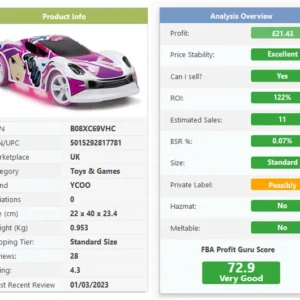
Amazon arbitrage in 2026 isn't about finding products; it’s about analyzing data.
If you are still sourcing products based on a "gut feeling" or just looking at the current Buy Box price, you are gambling, not investing. The difference between a six-figure seller and someone who gets suspended or goes broke often comes down to their deal analysis process.
In this guide, we’re breaking down the seven most common mistakes sellers make when evaluating Retail Arbitrage (RA), Online Arbitrage (OA), and Wholesale deals. More importantly, we’ll show you how to use tools like FBA Profit Guru to automate your risk assessment and avoid the "race to the bottom" that kills your margins.
1. The "Today Only" Price Trap
The biggest mistake new sellers make is looking at the current price and assuming it will stay there forever.
Amazon prices are volatile. If a product is selling for £30 today but has averaged £22 over the last six months, your profit calculation is a lie. When you buy at the peak, you are almost guaranteed to lose money when the price reverts to its historical mean.
The Fix: You must analyze the Price History. Look at 3-month and 12-month averages for the Buy Box, Amazon’s own price, and the New price. If the current price is significantly higher than the 90-day average, proceed with extreme caution.

Using our built-in price history tables, you can instantly see if a deal is a "spike" or a stable winner. Stability is your best friend.
2. Ignoring the "Tax Man" and Invisible Fees
If you are a UK-based seller, VAT is the profit killer.
Failing to distinguish between VAT-inclusive and VAT-exclusive cost prices, or forgetting to factor in VAT on your sales, will turn a 20% ROI deal into a loss instantly. Beyond taxes, many sellers forget "invisible" costs:
- Prep Center Fees: (£0.50 – £1.50 per unit)
- Inbound Shipping: The cost to get your items to Amazon’s warehouse.
- Storage Fees: Especially higher Q4 rates.
The Fix: Use a comprehensive Profit & Fee Calculator that handles UK VAT nuances and allows you to input custom prep and shipping costs.

Stop doing mental math. Automated tools ensure every penny is accounted for before you hit "buy."
3. The "Goldfish" Effect: Forgetting Brand Risks
You find a product with a 100% ROI. You buy 50 units. Two days later, you get an IP (Intellectual Property) Complaint or realize the brand is "gated" (restricted). Now your capital is tied up in stock you can't sell.
Many sellers act like goldfish, forgetting that certain brands are notorious for defending their listings or that Amazon requires specific invoices for certain categories.
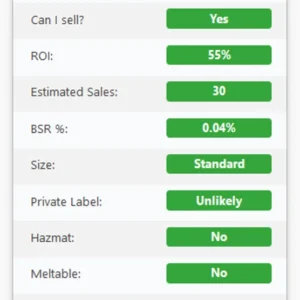
The Fix: Before you look at the profit, check your Eligibility & Alerts. You need real-time data on:
- Brand Restrictions: Are you actually allowed to sell this?
- IP Alerts: Has this brand filed complaints against resellers recently?
- Hazmat/Meltable: Is the product restricted due to safety or seasonal heat?

Checking these manually for every deal is a recipe for burnout. Our automated alert system does this check for you in milliseconds.
4. Chasing the Buy Box (The Race to the Bottom)
The "Race to the Bottom" happens when 20 sellers all see the same deal, buy the same stock, and then frantically lower their prices by £0.01 to "win" the Buy Box.
If you buy a product that already has a rapidly increasing seller count, you are walking into a trap. As supply skyrockets, the price will crash.
The Fix: Don’t just look at the price; look at the Offer Count History.
- If the number of FBA sellers is jumping from 5 to 50 in a month, the price is about to drop.
- Check the Competition Analysis to see how much stock your competitors are holding. If the top 5 sellers have 500 units each, you might want to pass.
5. Overestimating Your "Slice of the Pie"
A common mistake is seeing a product with 100 estimated sales per month and thinking, "Great, I'll sell 100 units!"
In reality, you are sharing those 100 sales with every other seller priced at the Buy Box. If there are 10 competitive FBA sellers, your "slice" is likely only 10 units per month.
The Fix: Use a competition breakdown to see who is actually winning the Buy Box. Our Competition Analysis table shows you the Buy Box Win % for the top 10 sellers, helping you estimate your realistic sales volume.

Strategy: Only buy what you can sell in 30 days to avoid long-term storage fees and capital tie-up.
6. Manual Analysis Burnout
Manual sourcing, copying titles into Amazon, checking Keepa manually, and typing numbers into a spreadsheet, is the slowest way to grow an Amazon business.
While you are manually checking one deal, an automated seller has already checked fifty and bought the top three. Manual analysis is a bottleneck that prevents scaling.
The Fix: Move to a software-led approach. Automation doesn't just save time; it eliminates human error. When you are tired at 11 PM, you will miss a VAT calculation or an IP alert. The software won't.
Read our comparison on Manual vs. Software-led analysis to see why the switch is mandatory for 2026.
7. Lacking Clear Exit Criteria
Many sellers buy anything that looks "okay." This leads to a messy portfolio of low-margin, high-risk products.
Without strict buying criteria, you'll find yourself holding stock that "breaks even" after months of waiting.
The Fix: Set your "Guru Criteria" and stick to them. Define your:
- Minimum ROI: (e.g., 30%)
- Minimum Profit: (e.g., £3.00)
- Maximum BSR (Sales Rank): (e.g., top 1%)
- Minimum Monthly Sales: (e.g., 20 units)

By setting these filters in your Custom Criteria Settings, the software will automatically flag deals that don't meet your standards, saving you from making emotional buying decisions.
Stop Guessing. Start Scaling.
The "Race to the Bottom" is only a threat to sellers who don't have the data to see it coming. By avoiding these seven mistakes and leveraging automated deal analysis, you can build a sustainable, profitable Amazon business that runs like a machine.
Ready to eliminate the guesswork?
Try FBA Profit Guru today and see how our automated analysis can safeguard your margins and find you better deals in half the time.