You found a product. The price looks right, the sales rank is low, and you’re already imagining the payout hitting your bank account.
But wait. Have you actually analyzed the deal, or are you just guessing?
In the world of Amazon Online Arbitrage (OA), Retail Arbitrage (RA), and Wholesale, guessing is the fastest way to lose money. Whether it’s an unexpected VAT bill in the UK, a sudden IP alert, or a price war that sends the Buy Box to zero, the risks are real.
If you want to survive and thrive in 2026, you need a repeatable, data-driven process. This guide will show you exactly how to analyze deals like a pro, using automation to eliminate human error and safeguard your margins.
Step 1: Define Your "Success Criteria" Before You Source
The biggest mistake beginners make is looking at every product as a potential winner. Without strict filters, you’ll end up "force-fitting" bad deals into your portfolio.
Do this first: Decide exactly what a "good" deal looks like for your business.
At FBA Profit Guru, we advocate for setting your Deal Analysis Criteria before you even open a product page. By defining your minimums, you can instantly filter out 90% of the junk.
- Minimum ROI (Return on Investment): Most experienced sellers aim for at least 30-40% to account for potential price drops.
- Minimum Profit: Don't chase pennies. Aim for a minimum of £3 or $3 per unit after all fees.
- Maximum BSR (Best Sellers Rank): Usually, staying within the top 1% to 3% of a category ensures the product actually moves.
- Minimum Monthly Sales: Aim for products with at least 10-20 sales per month to avoid stagnant inventory.

By using a tool like the FBA Profit Guru Deal Criteria Panel, you can automate this. If a product doesn't hit your 94.8 "Excellent" score, you move on. Speed is your greatest asset. Spending 20 minutes manually calculating a deal that was never going to work is a waste of your most valuable resource: time.
Step 2: The Silent Profit Killer – Mastering UK VAT and US Sales Tax
If you are selling in the UK or USA, taxes are not an "afterthought": they are a core component of your cost of goods sold (COGS).
The UK VAT Trap
In the UK, the price the customer sees on Amazon includes VAT. If you’re VAT-registered and sell a toy for £24, you aren't keeping £24. Approximately £4 of that belongs to HMRC.
Many manual spreadsheets fail here. They calculate profit based on the gross selling price, leading to a nasty surprise when the quarterly VAT bill arrives.
- Pro Tip: Always calculate your ROI on net-of-VAT revenue.
- The Receipt Problem: For RA/OA, many retail receipts don't show a VAT breakdown. If you can't prove the VAT paid on the purchase, you might not be able to reclaim it, further squeezing your margins.
US Sales Tax Nuances
For US sellers, you need to know where you have nexus. While Amazon collects and remits sales tax in most states, you are still responsible for registration and filing. Ignoring these "soft costs" can turn a 15% margin into a loss once compliance fees and penalties are factored in.

Using a dedicated Profit & Fee Calculator ensures you are looking at the real net profit. Our system breaks down every fee, from referral fees to FBA fulfillment and exact tax obligations, so you know your breakeven point to the penny.
Step 3: Avoid the "Race to the Bottom" with Historical Data
A product might look profitable today, but what about tomorrow?
Amazon prices are volatile. If you see 20 new sellers joining a listing, the "Race to the Bottom" is likely coming. To safeguard your profits, you must look at the Price History and Sales Rank Stability.

Don't just look at the current Buy Box. Use the built-in Keepa Integration to analyze the last 12 months:
- Price Stability: Is the current price an all-time high? If the 90-day average is 20% lower than the current price, assume the price will drop back down.
- Amazon Presence: Does Amazon frequently take the Buy Box and refuse to share? If Amazon is "in stock," your chances of getting sales are significantly lower.
- BSR Consistency: Does the sales rank spike and dip wildly, or is it a consistent performer? Consistent dips mean consistent sales.
Stop guessing and start predicting. By analyzing historical averages for the Buy Box and FBA lowest price, you can source with the confidence that your stock won't be sitting in a warehouse for six months.
Step 4: The Safety Checklist – IP Alerts and Restrictions
Nothing kills a business faster than an Inauthentic Product (IP) Complaint or a Brand Registry takedown.
Even if a product is profitable, you must check your Eligibility first.
- Brand Restrictions: Are you "gated" in this brand or category?
- Hazmat and Meltable: Sending meltable chocolate to a Florida warehouse in July is a recipe for disaster.
- Private Label (PL) Indicators: If a listing only has one seller and they are also the brand owner, do not touch it. You will likely receive an IP alert within days.

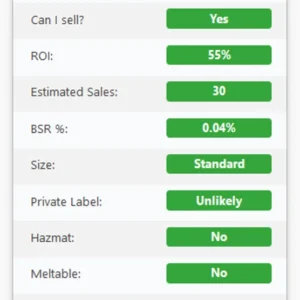
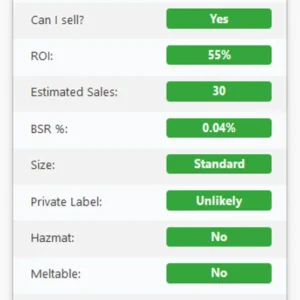
Our automated system provides real-time alerts for Hazmat, Meltable, and IP risks. In the example above, while the ROI is a massive 122%, a "Possible Private Label" flag is a signal to proceed with extreme caution. Safeguarding your account health is just as important as safeguarding your cash.
Step 5: Manual vs. Software-Led Analysis – The Reality Check
Is it possible to do all of this manually? Yes.
Is it profitable to do it manually? Rarely.
Manual analysis involves:
- Opening 5 different tabs (Amazon, Keepa, VAT calculator, Fee estimator, Google).
- Manually typing data into a spreadsheet.
- Risking a "fat-finger" error that costs you hundreds of dollars.
- Spending 10 minutes per ASIN.
Automated analysis with FBA Profit Guru takes seconds.
By streamlining your workflow, you can analyze 50 potential deals in the time it takes to do 5 manually. In the competitive world of Arbitrage, the seller who finds the lead first wins. Automation isn't a luxury; it’s a requirement for scaling.
Conclusion: Take Action Now
The difference between a "hobbyist" and a professional Amazon seller is the quality of their data.
If you want to stop making "expensive mistakes" and start building a predictable, profitable business, you need to stop doing the math yourself. Focus on sourcing and let the software handle the analysis.
Ready to safeguard your profits?
Start your 7-Day FREE Trial with FBA Profit Guru today and get instant access to our full suite of deal analysis tools, including IP alerts, Keepa charts, and VAT calculations.
Do this first:
- Set your personal deal criteria (ROI, Profit, BSR).
- Use a tool to verify eligibility and IP risk.
- Analyze the 90-day price history to avoid price wars.
- Calculate your true net profit, including all taxes and fees.
Stop guessing. Start growing.